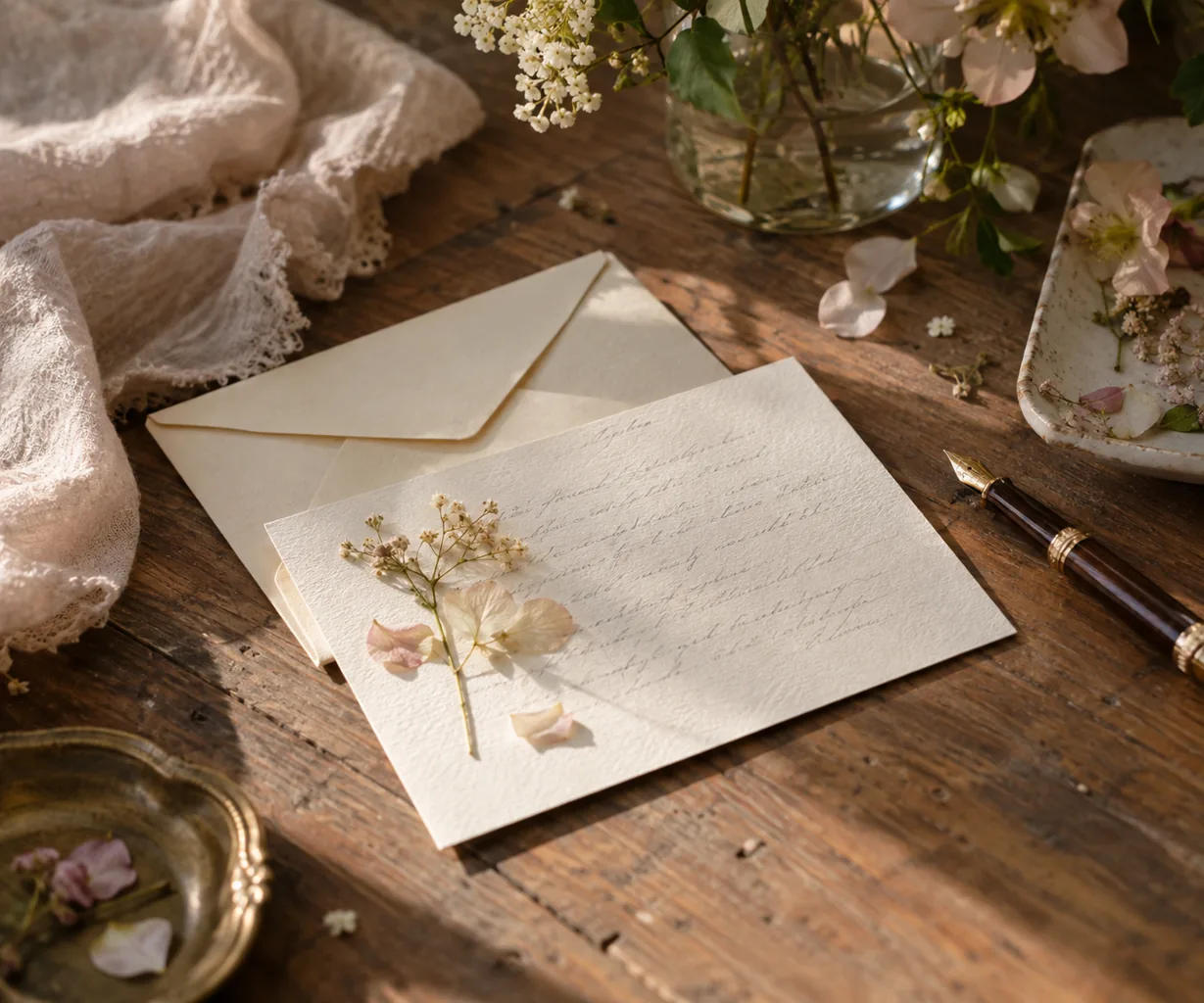
A memorable wedding card does not need a perfect quote. It needs one honest detail about the couple and a wish that sounds like something you would say aloud. Even three thoughtful sentences can carry more warmth than a page of borrowed language.
The three-part note
Begin with the occasion, add one specific connection, and close with a wish. That connection might be a shared memory, a quality you admire in their relationship, or a small observation about what makes the two of them happy together. Keep the scale right for your relationship. A coworker does not need an intimate childhood story; a sibling probably deserves more than “Best wishes.”
Before writing, say your first draft aloud. If it sounds like a speech you would never give, remove the grandest phrase. The couple will recognize your voice more readily than a polished generic line.
“Seeing the way you make room for each other, even on the busiest days, has been such a gift. I cannot wait to celebrate you both. Here's to a marriage full of ordinary, wonderful Tuesdays.”
“I have loved watching the two of you build a life together. Your home already feels like a place people can exhale. Wishing you years of laughter, patience, and new stories.”
“Congratulations on your wedding. It has been lovely hearing how excited you are for this next chapter. Wishing you a joyful celebration and many good years together.”
If you know one partner better
Write to both people, but do not invent familiarity. “I've known Alex for years, and it's wonderful to see the life you are creating together” is warmer and more accurate than pretending to have a deep relationship with both. If the card accompanies a gift, the gift need not become the subject of the note. Focus on the marriage and the people.
What to avoid
- Inside jokes that could embarrass someone if the card is read aloud.
- Advice about conflict, children, or money that the couple did not request.
- Assumptions about religion, gender roles, or the next milestones in their lives.
- A copied poem or quotation that occupies more space than your own words.
Humor can work if you know the couple well, but a card should still include a sincere line. For more wedding message ideas, treat examples as prompts and adapt them to the people you know.
When the circumstances are complicated
If a family member cannot attend, acknowledge the distance simply: “I'm sorry I cannot be there, but I will be thinking of you both.” If you are attending after a difficult year for the couple, it is fine to express hope without describing private hardship. If the couple has a child together, you can celebrate the family they have already made, provided that feels appropriate to your relationship.
For a bridal shower card, keep the message centered on the bride or couple and the upcoming celebration. A thank-you note has a different job: name the gift or act and explain why it mattered. The same principle of specificity works across all of them.
A short editing pass
Check the names and spelling. Read the note once for tone, then stop refining it. Handwriting does not need to be flawless; legibility matters more. Sign with the name the couple knows, especially if many guests share a first name. If you are helping plan the event, our guest arrival checklist covers the practical side of showing up well.
Finally, let the card be small. It is one thoughtful piece of a much larger day, and sincerity does not require length.
How to personalize an example without sounding stiff
Take the close-friend example and replace one phrase with something you have actually seen. “The way you make room for each other” might become “the way you both make a long train journey feel like a small adventure.” A concrete, ordinary detail can be more moving than a sweeping declaration. If you cannot think of one shared memory, name a quality you admire: kindness, humor, steadiness, curiosity, or the ease with which they welcome people.
For two people marrying after many years together, avoid treating the wedding as the beginning of the relationship. Celebrate the commitment and the life already built. For a second marriage, skip language about a “first and only” love. If the couple has asked for a particular tone or has cultural or religious customs, respect those preferences rather than assuming a standard line fits every situation.
When the blank card is intimidating
Draft three lines on a separate sheet: “Congratulations on…,” “I appreciate the way…,” and “I hope you….” Then remove those openings if they feel too formulaic. The structure is a scaffold, not finished wording. A little awkwardness is normal; a card is a personal note, not an audition. Write it before the wedding day so you are not trying to compose something meaningful in a parking lot.
Three closing lines that can carry the note
For an old friend, you might write, “I am so glad we get to celebrate the two of you in one room.” For a couple with a new home, “I hope the years ahead bring you the kind of days you will love remembering.” For someone you know mostly through work, “Wishing you both a warm celebration and a wonderful start to married life.” These are starting points, not lines you must use.
If the couple has requested a particular spelling of names or titles, use it. If you are unsure of a surname change, do not guess. The envelope can address both people by the names they use now. This small care matters more than any flourish.
A card given with a group gift can still have a personal line from each signer. When several people share one note, leave space for separate short messages instead of forcing a single collective voice. The couple can hear each person's good wishes without reading a long formal speech.
What if you want to include a quotation? Keep it brief and make sure the words fit the couple. Add a personal sentence after it so the card does not feel borrowed in full. If you do not know the source, avoid attributing a line to a famous person from memory. Your own words may be simpler and more accurate.
There is no deadline for perfect sentiment. If a card arrives after the celebration, a thoughtful late note is still welcome. Acknowledge the delay plainly if you wish, then return to the couple and your good wishes.